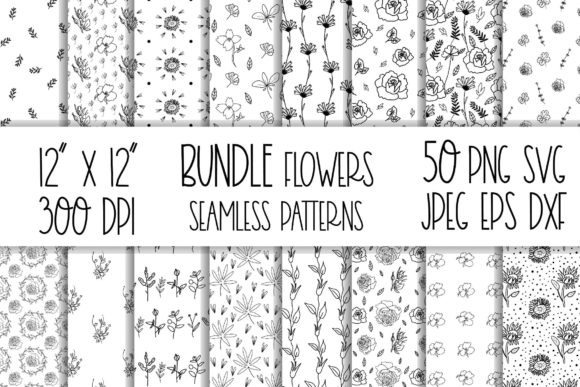
Seamless Floral Pattern SVG Black: A Versatile Vector Resource for Designers and Makers
Among the most enduring visual motifs in design, floral patterns carry cultural resonance, aesthetic flexibility, and timeless appeal. When rendered as a Seamless Floral Pattern SVG Black, this motif transcends decoration—it becomes a functional, scalable, production-ready asset. Unlike raster-based florals that degrade at larger sizes or when resized, the black vector variant delivers crisp edges, infinite scalability, and effortless integration across physical and digital workflows. Its transparency, precision, and resolution independence make it especially valuable in professional-grade output—from textile printing to web UI backgrounds.
What Makes This Bundle Technically Distinct?
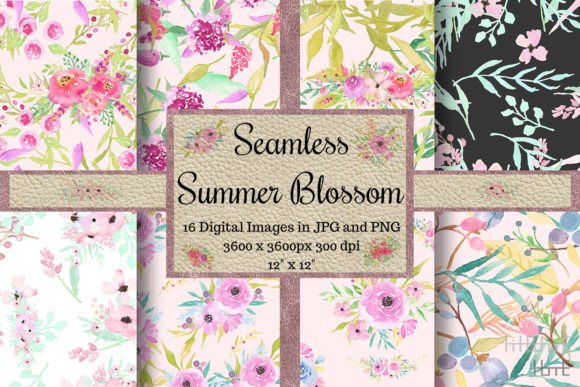
The collection—50 Seamless Patterns – PNG, SVG, DXF, EPS, JPEG (3600 × 3600 pixels, 12×12 inches, 300 DPI)—is engineered with technical rigor, not just visual variety. Each pattern is built on a mathematically precise tile boundary: no visible seams, no misaligned edges, no pixel drift—even after repeated tiling across meters of fabric or high-resolution billboards. The inclusion of SVG ensures compatibility with modern web standards, CSS background-repeat logic, and responsive design systems. Meanwhile, DXF and EPS formats support laser cutting, CNC engraving, and vector-based embroidery digitizing—use cases rarely served by generic clipart libraries.
The 300 DPI resolution at 12×12 inches isn’t arbitrary. It aligns with industry benchmarks for print-ready assets: sufficient detail for fine-line etching on cosmetic packaging, clarity for foil-stamped greeting cards, and fidelity for large-format wallpaper installations. And because every file includes a transparent background, designers avoid time-consuming masking or layer cleanup—especially critical when applying patterns to irregular shapes like bottle labels, app icons, or apparel mockups.
Designers and Brands: From Concept to Commercial Output
For graphic designers and branding professionals, the Seamless Floral Pattern SVG Black serves as both foundational texture and intentional visual language. A monochrome floral motif communicates sophistication without competing with typography or photography. It’s frequently used in luxury sectors—think minimalist perfume packaging where subtlety reinforces premium positioning—or in editorial layouts where texture adds depth without overwhelming content hierarchy.
Consider a boutique skincare line launching a limited-edition serum. Using one of these seamless patterns as a subtle background on product boxes, social media banners, and email headers creates visual continuity across touchpoints. Because the pattern is vector-based and black-on-transparent, it adapts seamlessly to gold foil stamping (via EPS), screen-printed tote bags (via DXF-guided registration), or animated Instagram Stories (via SVG + CSS transitions). No reworking, no resolution compromises—just consistent execution.
Textile and Surface Design: Beyond Paper and Screen
In textile development, seamlessness isn’t stylistic—it’s structural. A repeat that misaligns by even half a pixel causes visible “jogs” in woven fabric or knitted garments. These patterns are constructed using offset-tile methodology, verified across multiple tiling iterations in Adobe Illustrator and Affinity Designer. That verification matters: a fashion designer sourcing prints for silk scarves can scale the SVG up to 48 inches wide and still maintain registration accuracy for rotary screen printing plates.
Similarly, interior designers specifying wallcoverings benefit from the 3600×3600 pixel dimension—it maps cleanly to standard wallpaper roll dimensions (e.g., 20.5-inch width × 33-foot length) when tiled digitally prior to print RIP processing. The black-only palette also simplifies color separation for spot-color printing or CMYK conversion, reducing ink costs and improving predictability in production runs.
DIY Creators and Educators: Accessibility Meets Precision
Hobbyists using Cricut or Silhouette machines rely heavily on DXF and SVG files—but many free resources lack true seamlessness or embed hidden raster layers. This bundle avoids those pitfalls. Each DXF imports cleanly into cutting software with closed vector paths, no stray anchor points, and uniform stroke weights—critical for clean cuts on vinyl, leather, or balsa wood. A teacher designing classroom décor can use the same file to cut stencils for bulletin boards and generate printable PDFs for student art projects—all without switching tools or adjusting scale.
For educators teaching digital design fundamentals, the set functions as a pedagogical tool. Students can inspect the SVG code to understand how
Web and Interactive Media: Performance and Flexibility
On the web, SVG isn’t just about scalability—it’s about performance and control. A single Seamless Floral Pattern SVG Black file, often under 5 KB, replaces multiple high-res JPEGs or CSS-generated gradients. It loads instantly, scales responsively, and respects user preferences like forced dark mode (since it contains no embedded color values beyond black and transparency). Developers can manipulate its opacity, apply blend modes via CSS, or animate tile offsets for subtle parallax effects—all without triggering layout shifts or repaint bottlenecks.
Bloggers and content creators integrating patterns into WordPress themes or Notion dashboards benefit from the dual-format availability: SVG for live sites, PNG for static previews or email clients with limited SVG support. The consistent 3600×3600 dimension also simplifies CMS image handling—no need for custom crop ratios or aspect-ratio locking when generating featured image thumbnails.
Practical Considerations for Real-World Use
While versatility is a strength, effective implementation requires attention to context. For example, using a dense floral pattern as a full-page website background may reduce readability if text overlays lack sufficient contrast or blur filters. In such cases, designers often apply the pattern at low opacity (10–15%) or isolate it to section dividers or decorative borders—leveraging its structure without sacrificing function.
Color adaptation is another practical nuance. Though delivered in black, the SVG format allows easy recoloring via CSS filter: hue-rotate(), inline fill attributes, or global swatch replacement in design tools. A wedding planner might shift the same pattern to soft blush for invitations and charcoal gray for signage—retaining brand cohesion while tailoring tone.
File management also warrants attention. With five formats per pattern, version control matters. Best practice is to archive master EPS/SVG files separately from production-ready JPEG/PNG exports—and name files descriptively (e.g., floral_vine_black_seamless_07_svg rather than pattern1.svg). This prevents accidental use of low-res assets in print jobs and streamlines collaboration across teams using different software ecosystems.
Integration Across Disciplines: A Unifying Asset Class
What unites fashion illustrators, packaging engineers, and social media managers isn’t just access to floral motifs—it’s reliance on assets that behave predictably across constraints. A cosmetic brand’s lipstick tube may require embossed patterning (DXF), its Instagram feed needs animated SVG backgrounds, and its retail shelf talker demands 300 DPI JPEGs for large-format printing. One source file, five formats, zero reinterpretation.
This interoperability reflects broader industry movement toward “format-agnostic design”—where assets are created once, validated thoroughly, and deployed flexibly. The Seamless Floral Pattern SVG Black exemplifies that shift: it doesn’t replace creative judgment, but removes technical friction from executing it. Whether generating a batch of thank-you cards in Canva, prepping files for DTG shirt printing, or building a Figma design system with reusable pattern tokens, the underlying reliability remains constant.
Long-Term Value Beyond Aesthetics
Unlike trend-dependent graphics, monochrome seamless florals possess longevity. They avoid seasonal color palettes or faddish illustration styles, making them suitable for multi-year brand guidelines or institutional templates. Universities updating alumni newsletters, nonprofits refreshing annual reports, or municipalities redesigning civic signage all benefit from patterns that age gracefully—without requiring quarterly rework.
Moreover, the transparency and vector foundation future-proof the assets. As new output channels emerge—AR surface mapping, generative print-on-demand APIs, or AI-assisted layout tools—these files integrate more readily than fixed-raster alternatives. Their mathematical precision aligns with algorithmic tiling logic, and their minimal color profile reduces processing overhead in automated workflows.
In essence, the Seamless Floral Pattern SVG Black isn’t merely a decorative download. It’s a carefully engineered component in a larger design infrastructure—one that balances artistic expression with engineering discipline, accessibility with professionalism, and simplicity with far-reaching utility.