Floral Borders: Ornate, Seamless, and Ready for Real Creative Work
If you’ve ever spent hours tracing a scanned lace motif, adjusting spacing on a repeating pattern, or wrestling with pixelation when scaling a border for a large-format print—you’ll recognize the quiet relief that comes with finding a truly versatile, production-ready Floral Borders set. This isn’t just another collection of pretty frames. It’s a practical toolkit built for designers, crafters, marketers, and small-business owners who need elegance without compromise—and speed without sacrificing quality.
What Exactly Is Floral Borders?
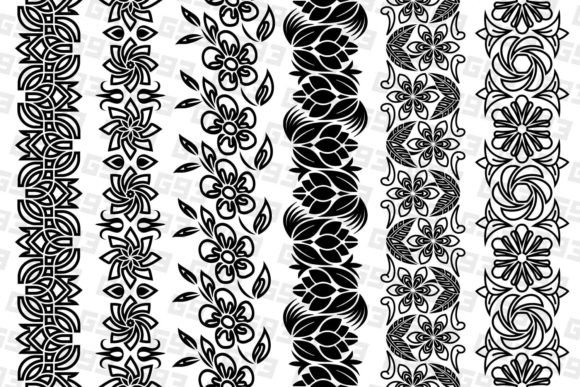
Floral Borders is a curated set of six ornate, black-and-white lace-inspired design elements—each crafted as a seamless, repeatable pattern. Think delicate arabesque swirls, interwoven vines, and finely detailed blossoms—not stiff clipart, but fluid, organic motifs designed to tile flawlessly across any surface. What makes it especially useful is how it’s delivered: six high-resolution JPGs (300 ppi), six transparent-background PNGs (also 300 ppi), and six vector files (SVG, AI, and EPS 10)—all matching the same six core designs. That means whether you’re laying out a wedding invitation in InDesign, prepping a sublimation print for fabric, or building a Shopify banner in Canva, you’ve got the right format, ready to drop in.
Where These Floral Borders Actually Show Up in Everyday Projects
These aren’t “just for invitations.” In fact, their most powerful uses often happen outside traditional stationery:
- Small-batch product packaging: A candle maker used the SVG version to wrap around a cylindrical label—scaling it smoothly from 2” to 8” without blur or distortion. The black-and-white contrast gave her minimalist branding a tactile, artisanal warmth.
- Digital course assets: An online educator added the PNG borders as subtle dividers between modules in her PDF workbook. Because they have transparent backgrounds, they layered cleanly over soft pastel backgrounds—no white boxes breaking the flow.
- Embroidery and textile design: A fiber artist imported the AI files into embroidery software, converted them to stitch paths, and digitized two of the borders for machine-embroidered pillow edging. The clean vector curves translated directly into smooth satin stitches.
- Social media templates: A real estate agent overlays the JPG versions onto Instagram Story templates—using them as elegant frame elements around property photos. Since they’re 300 ppi, they hold up crisp even when cropped or zoomed on mobile screens.
- Wall decals and signage: A boutique owner printed one of the SVG borders at 6 feet wide for a vinyl wall decal behind her checkout counter. No moiré, no jagged edges—just sharp, scalable detail that reads beautifully from across the room.
Who Benefits—and How Their Needs Shape the Choice
The beauty of this Floral Borders set lies in how differently people use it—not because the files change, but because their workflow does.
A print designer will likely reach first for the EPS or AI files—especially when preparing files for commercial printers who require vector assets for die-cutting or foil stamping. They’ll appreciate that EPS 10 compatibility means no surprises in older RIP systems.
A handmade seller on Etsy might skip straight to the PNGs. They’re drag-and-drop friendly in Canva or PicMonkey, work instantly in Cricut Design Space, and scale cleanly for digital downloads—even if the user doesn’t know what “vector” means. The transparency means no extra clipping or background removal before uploading to a POD (print-on-demand) service.
A web developer building a custom WordPress theme may extract the SVG code directly and embed it inline—allowing CSS color overrides (yes, you can recolor the black lines to gold or sage green) and responsive resizing without loading separate image files.
Things to Keep in Mind Before You Start Using Them
While these Floral Borders are flexible, a few practical considerations help avoid hiccups:
- Seamless ≠ automatic alignment: Though each pattern repeats perfectly edge-to-edge, some applications (like certain embroidery software or older versions of Photoshop) may require you to manually define the tile boundary or adjust offset values. Always test a small repeat first.
- Black-and-white doesn’t mean monochrome-only: These are grayscale designs—but because they’re high-res and clean-lined, they convert beautifully to duotones, spot-color separations, or even reversed-out white-on-black layouts. Just avoid applying heavy filters or auto-contrast adjustments that could blur fine details.
- “Ornate” has a sweet spot: These borders shine at medium to large sizes (1–4 inches tall in print, or ~200–800px wide digitally). At very small scales—like a 12px divider in email HTML—they may lose legibility. For micro-applications, consider simplifying or using only a single motif instead of the full repeat.
- Licensing clarity matters: This set is intended for both personal and commercial use—including client work and physical products—but always verify the included license terms. Some platforms restrict use in templates you resell; others allow it freely. When in doubt, check the source documentation—not assumptions.
Why This Set Stands Out Among Other Floral Patterns
There’s no shortage of floral graphics online. What makes this Floral Borders collection different is its intentional balance of artistry and utility:
- No filler, no fluff: Six designs—not 50—means each one was refined for versatility. You won’t scroll past twenty similar-looking vines to find the one with the right curve density.
- Consistent density and line weight: All six share the same visual rhythm and stroke thickness. That consistency lets you mix and match borders across a brand system (e.g., one for business cards, another for thank-you notes) without clashing.
- True 300 ppi across raster formats: Not upscaled, not interpolated—each JPG and PNG was rendered at full resolution from the original vector source. That difference shows up sharply in printed brochures or photo books where detail retention matters.
- Real-world testing baked in: These weren’t designed in isolation. They’ve been stress-tested in actual production environments—from DTG garment printing to laser-cut wood signs—so the vectors hold clean corners and the repeats stay stable under real file-handling conditions.
A Final Thought: Elegance Should Be Accessible, Not Exhausting
You don’t need a degree in pattern design to bring sophistication to your work. What you do need is reliable, well-built assets that respect your time and your standards. With Floral Borders, the ornate details are already resolved—the seamless tiling is already solved—the format flexibility is already built in. Your job isn’t to recreate beauty from scratch. It’s to place it thoughtfully, adapt it meaningfully, and let it elevate what you’re already making.