Chevron and Stripes Retro Digital Papers
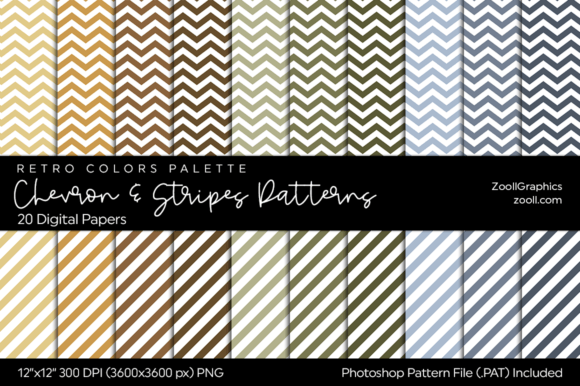
Chevron and Stripes Retro Digital Papers is a curated collection of 20 seamless, tileable digital pattern files designed for creative projects requiring retro-inspired visual texture. Each pattern combines classic chevron and stripe motifs in a cohesive palette of dusky retro tones—think muted orange, earthy brown, sage green, and soft blue. The set includes high-resolution PNG files (3600 × 3600 pixels at 300 dpi, sized to 12 × 12 inches) and a single Photoshop PAT file for direct pattern library integration.
What This Collection Offers—and What It Doesn’t
The primary value lies in its consistency and technical readiness: all 20 patterns are truly seamless, meaning they repeat without visible breaks or alignment artifacts when tiled across large surfaces or layered in design software. This eliminates the need for manual editing or blending—a practical advantage for users working on scalable layouts like planner backgrounds, invitation suites, or printable gift wrap sheets.
It does not include vector files, editable source layers, or color variants beyond the fixed retro palette. There are no pre-designed templates (e.g., calendars, card fronts, or social media banners), nor are there instructions for specific software workflows. Users seeking fully customizable assets or broader color flexibility will need to adjust expectations—or supplement this set with additional resources.
Who Might Benefit Most
This collection suits creators who prioritize time-efficient, print-ready textures with a distinct mid-century aesthetic. Scrapbookers building themed layouts around 1960s–1970s design sensibilities may find the muted orange and brown combinations especially useful for vintage photo mats or journaling cards. Planner enthusiasts often use such patterns as subtle background fills for weekly spreads or habit trackers—where legibility and visual calm matter more than bold contrast.
Designers preparing physical outputs—including party invitations printed on matte cardstock or hand-wrapped gifts using custom-printed paper—benefit from the 300 dpi resolution and CMYK-friendly color range. The inclusion of a Photoshop PAT file also supports users who frequently apply repeating patterns in layered documents, reducing repetitive drag-and-fill steps.
Practical Considerations Before Downloading
Compatibility depends on your workflow. The PNG files work universally across design applications (Canva, Affinity Designer, Procreate, Cricut Design Space), but the PAT file is exclusive to Adobe Photoshop (and compatible derivatives like Photopea). If you rely primarily on non-Adobe tools, the PAT file adds little functional value—though the PNGs remain fully usable.
File size is another factor: the ZIP archive contains 20 high-resolution raster images. At approximately 15–25 MB total (depending on compression), it’s manageable for most connections—but users with limited storage or older devices may want to verify available space before extraction.
Color accuracy is tied to monitor calibration and output method. While the dusky retro palette renders consistently on sRGB displays, printed results can vary depending on paper type, ink profile, and printer model. Soft proofing in Photoshop or test prints on your intended stock is advisable before committing to large-format runs.
When Alternatives May Be More Appropriate
If your project demands precise color matching—such as aligning with a brand’s Pantone palette—this set offers limited flexibility. The fixed hues cannot be adjusted without altering the pattern’s integrity or introducing banding in gradients. In those cases, a vector-based chevron/stripes pack with editable swatches or a generative tool that allows real-time color shifts may better support iterative design needs.
Similarly, users focused on web or UI design may find the 12 × 12 inch raster dimensions unnecessarily large for screen-based assets. While PNGs can be resized downward, repeated scaling risks pixelation if original proportions aren’t preserved. For responsive web backgrounds, CSS-generated stripes or SVG patterns offer smaller file sizes and infinite scalability without quality loss.
For educators or hobbyists introducing pattern design concepts to beginners, a collection with layered PSD files (showing how chevrons and stripes are constructed) would provide greater learning value. Chevron and Stripes Retro Digital Papers delivers finished assets—not pedagogical scaffolding.
Making a Purposeful Choice
Evaluating whether Chevron and Stripes Retro Digital Papers fits your needs starts with clarifying your end use. Ask yourself:
- Is visual cohesion across multiple projects important? The unified color palette and consistent motif language help maintain stylistic continuity—especially helpful if you’re developing a themed product line or personal brand identity rooted in retro aesthetics.
- Do you need reliability over customization? Seamless tiling and print-ready resolution reduce trial-and-error. If speed and predictability outweigh the desire to tweak every element, this set reduces friction.
- Are you working within constraints that favor raster over vector? Physical printing, scrapbooking digitals, or platforms that don’t support SVG uploads make high-res PNGs a pragmatic choice—even if they lack the infinite scalability of vector alternatives.
Conversely, if your goals involve frequent recoloring, multi-device responsiveness, or educational reuse, investing time in learning pattern generation tools—or selecting a more modular asset library—may yield longer-term utility.
Final Thoughts for Intentional Use
Chevron and Stripes Retro Digital Papers occupies a specific niche: it serves creators who value aesthetic consistency, tactile-inspired digital texture, and immediate usability in tangible output contexts. Its strength isn’t versatility—it’s focus. The retro palette isn’t arbitrary; it reflects intentional design choices that suit analog-adjacent applications like paper crafts and printed ephemera.
No digital pattern pack replaces thoughtful layout decisions or content strategy. But when aligned with clear goals—such as reinforcing a warm, nostalgic mood across a suite of handmade invitations or adding quiet rhythm to a minimalist planner—the right set of seamless patterns becomes a functional design tool rather than just decoration.
Before acquiring, confirm that your software environment supports the included formats, that your output medium benefits from raster-based textures at this resolution, and that the color direction matches your project’s expressive intent. When those conditions align, Chevron and Stripes Retro Digital Papers provides a grounded, efficient foundation—not a shortcut, but a considered starting point.